Auditable
A real accessibility audit, mapped to the line that caused it.
VS Code extension Final testing — not yet on the Marketplace levelbrook.auditable v1.0.0
Status — Auditable 1.0.0
Built, tested and packaged as a .vsix. It is not published to the VS Code Marketplace or Open VSX yet — the publisher account is the last step. There is nothing to install today.
The purchase links on this page are live, so you can buy today and activate the moment the extension is published. If you would rather wait, mail team@levelbrook.com and we will tell you when it ships.
Why this exists
EU member states have had to apply the European Accessibility Act's measures since 28 June 2025 (Directive (EU) 2019/882, Article 31(2)). If you build for the product and service categories it enumerates — e-commerce, banking, ticketing, e-books, transport — accessibility stopped being a nice-to-have and became a requirement with a budget line attached.
Read the scope before you quote anyone
A directive is enforced through each member state's national transposing law, not directly. The Act covers the categories listed in Article 2 — it is not a blanket requirement on every website. Article 4(5) exempts microenterprises providing services. Article 32(1) sets a transitional period running to 28 June 2030 for services using products lawfully in use before that date, and lets service contracts agreed before 28 June 2025 run to expiry, up to five years.
Auditable prints all of that in the report, so an agency is not the one guessing. None of it is legal advice, and whether any of it applies to a given organisation is a legal question.
The tools on offer are mostly overlay widgets at $490–$3,990 a year that claim to make a site compliant by injecting JavaScript. They do not. In January 2025 the FTC announced a settlement requiring accessiBe to pay $1 million over allegations that it “misrepresented the ability of its AI-powered web accessibility tool to make any website compliant with the Web Content Accessibility Guidelines”. The final consent order was approved in April 2025 (FTC File No. 2223156) — an administrative consent order with no admission of liability, and a concluded matter, not an ongoing case. The Overlay Fact Sheet, signed by practitioners opposing the practice, listed 1,031 signatories when it was read on 3 September 2026.
Meanwhile the platforms most sites are actually built on ship no real audit tooling at all, and point their users at those same overlays.
Auditable is the honest version: a real rule engine, in your editor, that tells you the truth about its own limits and produces a document you can hand to a client. It runs axe-core 4.13 against a file, a dev server or a URL, maps each violation back to the exact line in your source, and turns the result into a report you can send.
The honest number, up front
Automated testing can evaluate only a minority of WCAG success criteria. In the published audit data from Deque — who make axe-core, the engine Auditable runs — automated tests found issues against 16 of the 50 WCAG 2.1 Level AA success criteria.
Deque also publish a much higher figure, 57.38%, for the share of individual issue instances automation catches across roughly 300,000 issues on 13,000+ page states. Both numbers are real and they measure different things. Conformance is claimed against criteria, not against issue counts, so the by-criterion figure is the one this tool is built on — it is the more conservative of the two, and it is checkable.
The W3C Web Accessibility Initiative publishes no percentage at all. What it does say is: “no tool alone can determine if a site meets accessibility standards. Knowledgeable human evaluation is required.”
That limit is a property of the technique, not of this tool, and no automated product can honestly claim otherwise. A machine is good at questions with one correct answer: does this image have an alt attribute, does this text meet a contrast ratio, is this ARIA attribute valid for this role. A machine cannot decide whether the alt text actually describes the image, whether the focus order makes sense, whether an error message helps a user recover, or whether a custom widget is genuinely operable by keyboard.
Auditable will never be sold as “compliance”. It produces evidence. A human still has to do the judgement, and that is a feature of honest tooling, not a gap in it.
Free, forever
- Scan the active file, scan a URL or dev server, or scan every HTML file in the workspace.
- Violations mapped to the exact source line, surfaced as VS Code diagnostics with a configurable severity. Five mapping strategies, and when it cannot place an element it reports no line rather than guessing wrong.
- Scan on save,
include/excludeglobs, and a configurable viewport and wait so a client-rendered page settles before it is measured. - Group results by severity, by rule or by page; copy an issue; re-run the last scan.
- Explain this rule — what the rule means, which WCAG 2.2 success criterion and EN 301 549 clause it maps to, and how to fix it. All 105 rules are covered and every mapping is checked against axe's own tags.
- Methodology and limitations, in the product, not in a footnote.
- Export results as JSON.
- No telemetry, no account, no overlay, and it never downloads a browser — it finds a headless Chromium you already have, and drives it over a pipe rather than a listening port, so a crashed editor cannot leave an orphaned browser behind.
Pro
| Feature | Free | Pro |
|---|---|---|
| Scan a file, a URL, a dev server or the whole workspace | Yes | Yes |
| Violations mapped to the source line, as diagnostics | Yes | Yes |
| Group by severity / rule / page, explain a rule, copy an issue | Yes | Yes |
| Methodology and limitations documentation | Yes | Yes |
| Export results as JSON | Yes | Yes |
| Client-ready WCAG 2.2 audit report (HTML and a real PDF) | — | Yes |
| Crawl and audit a whole site (depth and page limits, same-origin) | — | Yes |
| Progress since the last audit — trend across scans | — | Yes |
| VPAT / ACR draft generation | — | Yes |
| SARIF export for GitHub code scanning | — | Yes |
| JUnit XML export for CI | — | Yes |
| Report branding — organisation, client, logo, accent colour | — | Yes |
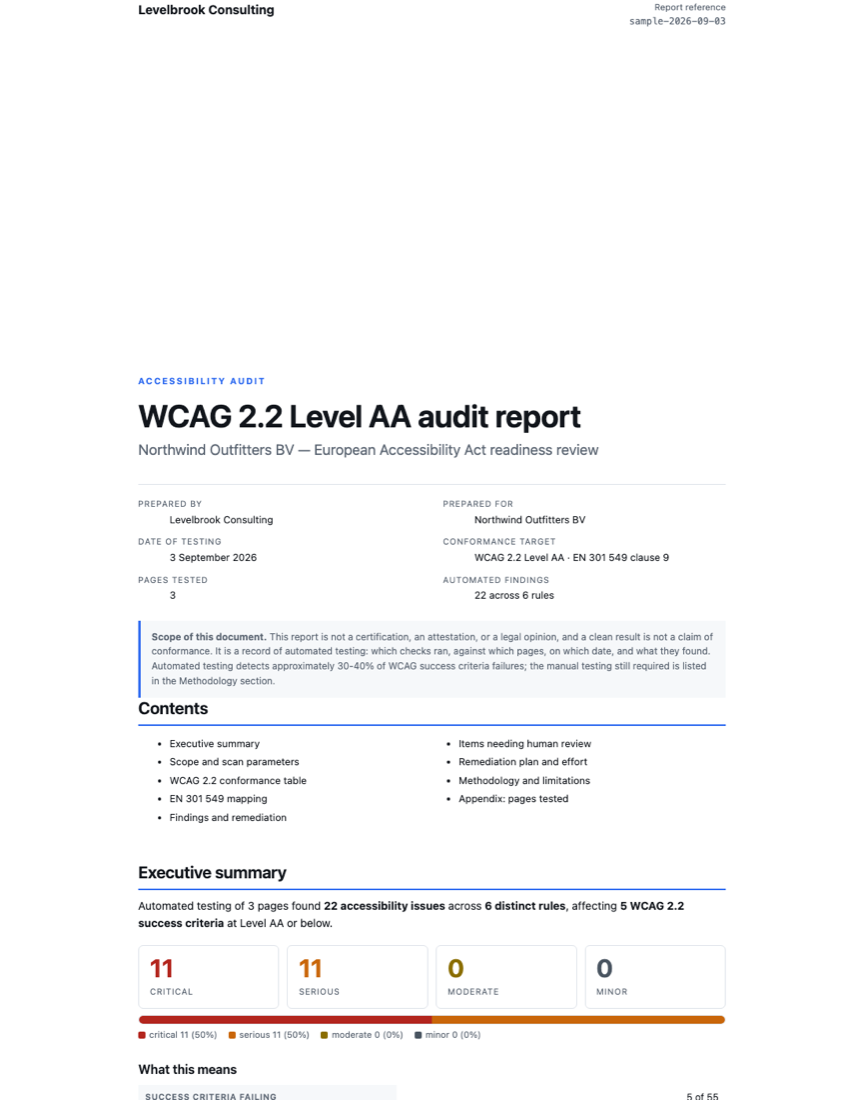
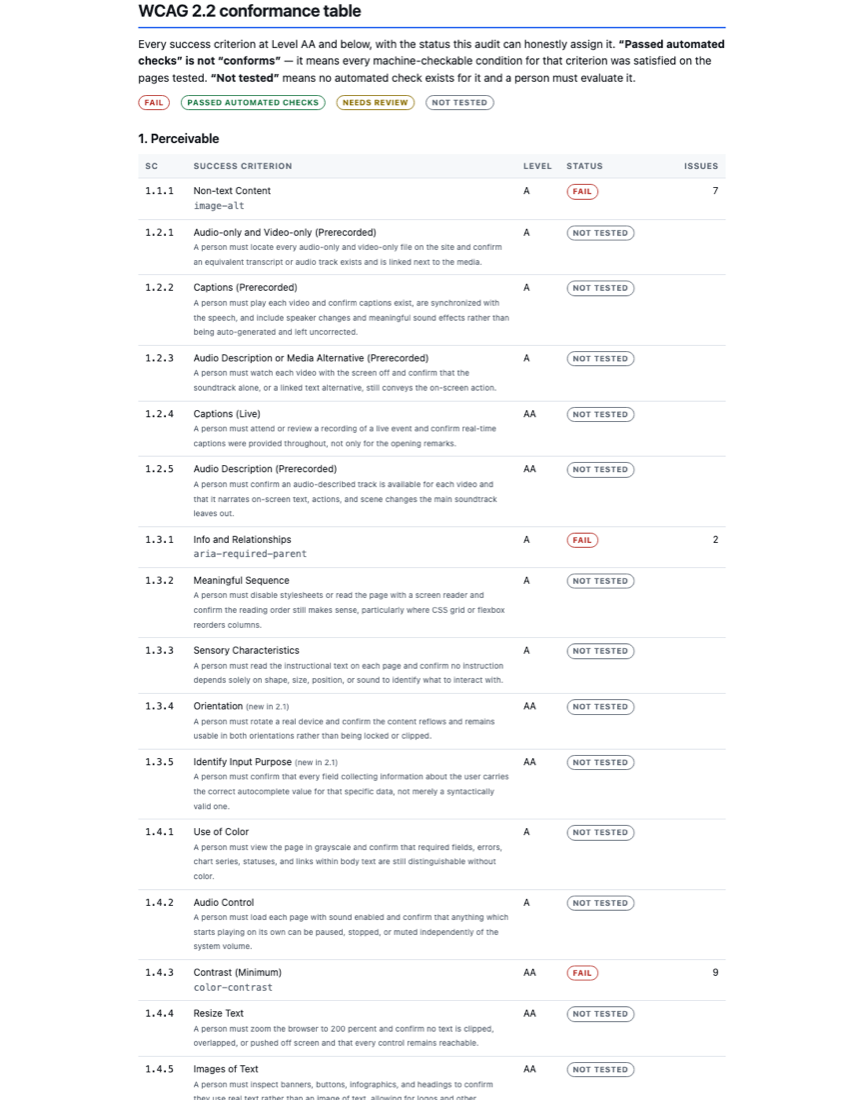
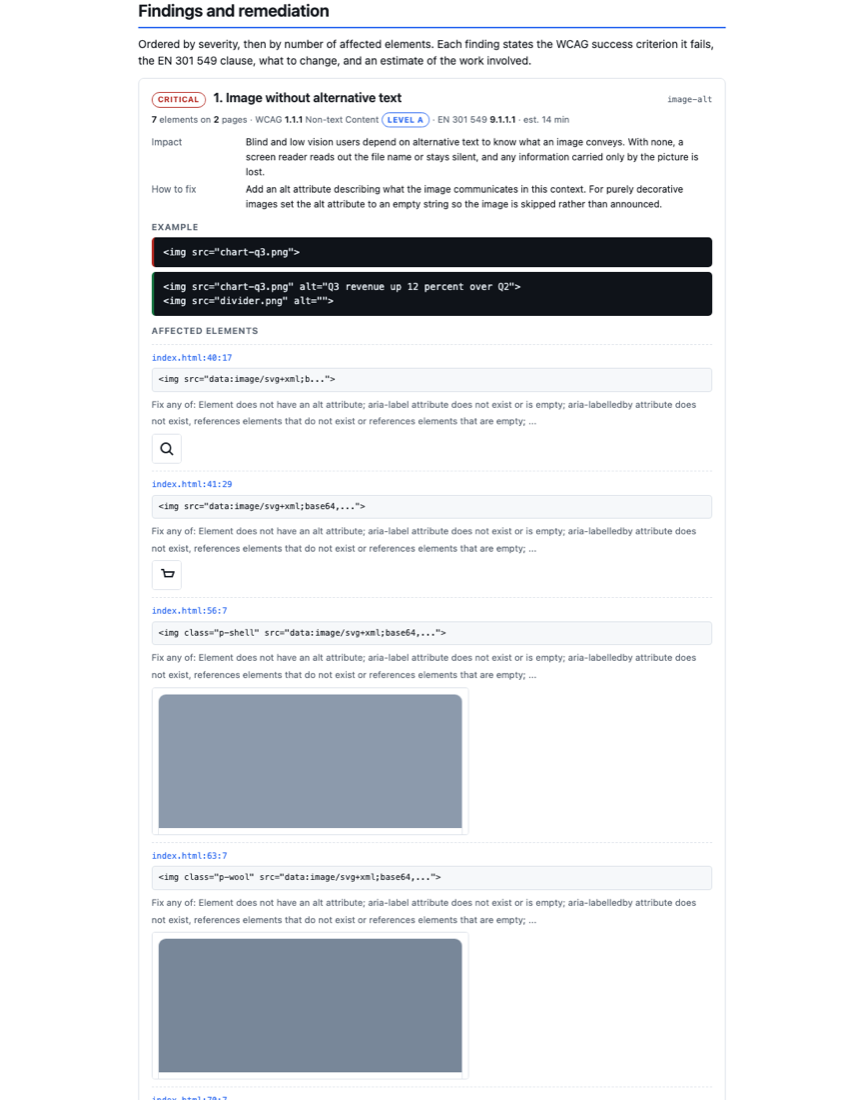
Auditable is priced against the thing it replaces. An overlay subscription starts around $490 a year and never ends. This is $149 once.
Free
$0 · permanent
Not a trial. Not a countdown. The free tier listed above never moves behind a paywall — that is the whole point of the pledge.
Read the pledgePro — lifetime
$149 once
- Every Pro feature, on every machine you own
- One year of updates included; the version you bought keeps working forever
- No account and no email address required to use it
Pro — monthly
$19 / month
- The same Pro feature set
- Cancel at any time from the Stripe receipt
A 14-day trial starts the first time you use a Pro feature. No account, no email address, no card and no request to any server. Payment is handled by Stripe; we never see your card details. Your entitlement is an Ed25519-signed token that is verified offline, so Pro keeps working when you do not have a network.
Already bought it and lost the key? Recover your licence key.
Where EN 301 549 actually stands
The report includes an EN 301 549 clause 9 mapping, with the clauses outside a web scan's scope named as such rather than quietly ignored. It also prints the standard's real citation status, because a mapping is otherwise easy to misread as a legal claim:
EN 301 549 is currently cited in the Official Journal of the European Union under the Web Accessibility Directive (EU) 2016/2102, at version V3.2.1 (2021-03). It was prepared under the Commission's standardisation request for the European Accessibility Act, but it has not yet been cited in the Official Journal under that Directive, so conformance with it does not currently confer a presumption of conformity with the European Accessibility Act.
For what it is worth on the technical side: EN 301 549 V4.1.1 (2026-09) clause 9.0 treats
conformance with WCAG 2.2 Level AA as equivalent to its web requirements, while V3.2.1
— the version currently cited — maps to WCAG 2.1 AA. Auditable's
standard setting lets you run either tag set.
Not in 1.0, and not charged for as if it were
No test has ever rendered a tree item, a diagnostic or a webview in a real extension host. 108 tests pass, including a harness that activates the bundled extension and proves all 23 declared commands are registered with no mismatches, and the scanner is verified against ten broken fixtures where every reported line number is asserted to be exact. But the editor-facing UI layer is covered by a stubbed VS Code API rather than a real one, and that is the single largest untested surface in the product.
Also unproven or untested: the crawler has never been run against a real
multi-page website (only single-page and file scans); the report
logoPath option has never been exercised with a real logo file;
only macOS on Apple silicon was run, so Windows and Linux browser
detection is written but unexercised; and the in-editor paste-a-key flow that flips the
Pro gate has not been driven by hand, though the licence round trip itself has been
exercised against the live service.
Two limits that are design decisions rather than defects: a template whose element is assembled from variables may scan correctly through a dev server but not map back to a line, and if JavaScript rewrites an element after load the mapper degrades to a tag ordinal and then to nothing. In both cases it reports no line rather than a wrong one.
Licensing of what it ships
Auditable's own code is MIT. axe-core is licensed under the Mozilla Public License 2.0, not MIT. It is shipped unmodified, as a separate file, with its licence alongside it — which is what MPL-2.0 §3.3 requires, and which leaves Auditable's own MIT code unaffected. The full notice ships in the extension.
Auditable is not affiliated with or endorsed by Deque Systems, who develop axe-core.
Sources for everything on this page: Directive (EU) 2019/882 and Commission Implementing Decisions (EU) 2018/2048 and 2021/1339 on EUR-Lex, EN 301 549 V3.2.1 and V4.1.1, the FTC's published consent order (File No. 2223156), and Deque's own published coverage data.