
Mentionable
Are AI answer engines citing your site?
Chrome extension Final testing — not yet on the Chrome Web Store levelbrook.mentionable v1.0.0
Status — Mentionable 1.0.0
Built, tested and packaged as a Manifest V3 .zip. It is not published to the Chrome Web Store yet — the publisher account is the last step. There is nothing to install today.
Publishing also needs the Chrome Web Store's one-time $5 developer registration fee, and as far as this build knows it has not been paid.
The purchase links on this page are live, so you can buy today and activate the moment the extension is published. If you would rather wait, mail team@levelbrook.com and we will tell you when it ships.
Why this exists
The category above this one charges $29 to $489 a month and runs the queries on its own infrastructure, which is why it costs what it costs. Mentionable runs them from your browser with your API key, so there is no usage for anyone to meter.
No account, no server of ours in the request path, and no telemetry of any kind. Every provider request goes browser → provider, directly. We never see your key, your prompts or your results, because there is nowhere for them to go.
Free, forever
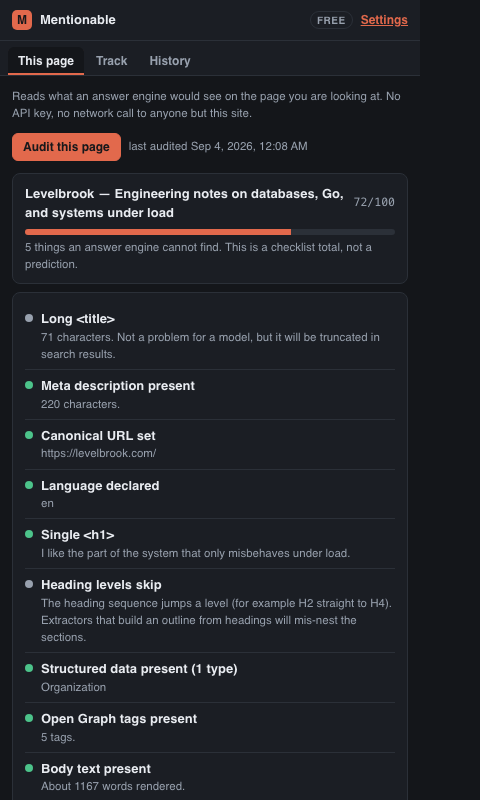
Audit any page — no key required
Click the toolbar icon and Mentionable reads exactly what an answer engine can read about
the page: <title>, meta description, canonical,
<html lang>, the heading outline, schema.org JSON-LD, Open Graph, image
alt text, /llms.txt and /robots.txt — the last checked
against 19 named AI crawler user-agents, so you find out whether you are
blocking the very engines you want to be cited by. Then it tells you plainly what is
missing.
Track prompts across engines
Add the questions your buyers actually ask, add your brand and your competitors, and run them against OpenAI, Anthropic, Google Gemini or Perplexity. For every answer you get mentioned (did your name, an alias or your domain appear in the prose), cited (did a link or a returned citation actually point at your domain), position (where you first appeared relative to the others) — and the raw answer, kept, so you can audit our parsing instead of trusting it.
Local history, share of voice, and CSV and JSON export are all free, permanently.
Pro
| Feature | Free | Pro |
|---|---|---|
| Page audit (no API key needed) | Yes | Yes |
| Tracked prompts and brands | Yes | Yes |
| Mention / citation / position per run | Yes | Yes |
| Raw answers kept, CSV + JSON export | Yes | Yes |
| Run history and share of voice | Yes | Yes |
| Projects | One | Unlimited |
| Scheduled tracking | — | Yes |
| Share of voice over time | — | Yes |
| Client-ready HTML / print-to-PDF report | — | Yes |
| Bulk prompt import | — | Yes |
| Competitor auto-suggest from the answers | — | Yes |
The 14-day trial starts the first time you use a Pro feature — not at install, so it does not run down while the extension sits unused in your toolbar.
Free
$0 · permanent
Not a trial. Not a countdown. The free tier listed above never moves behind a paywall — that is the whole point of the pledge.
Read the pledgePro — lifetime
$99 once
- Every Pro feature, on every machine you own
- One year of updates included; the version you bought keeps working forever
- No account and no email address required to use it
Pro — monthly
$12 / month
- The same Pro feature set
- Cancel at any time from the Stripe receipt
A 14-day trial starts the first time you use a Pro feature. No account, no email address, no card and no request to any server. Payment is handled by Stripe; we never see your card details. Your entitlement is an Ed25519-signed token that is verified offline, so Pro keeps working when you do not have a network.
Already bought it and lost the key? Recover your licence key.
What it is not
This is the part the category leaves out, so it is at the top of the extension's own settings screen as well as here.
- One run is a sample, not a measurement. Model output is non-deterministic and personalised — ask the same question twice and you can get two different lists. Every figure Mentionable shows carries its run count and a 95% Wilson interval, and with a handful of runs that interval is wide. That is the honest picture, and it is why this is a tracking tool rather than a scoreboard.
- These are API responses, not consumer products. Mentionable calls a documented HTTP API. That is not the same surface as the ChatGPT app, Google's AI Overviews or the Perplexity website, and it will not always agree with them. Every run records the exact endpoint and the exact model id the API reported.
- “Position” is order of appearance inside one answer. It is not a search ranking.
- Detection is string matching on names, aliases, domains, link targets and returned citations. It does not judge whether a mention was favourable and does not pretend to.
- Mentionable does not improve anything. It measures and reports. It is not an “AI SEO” service and makes no claim that anything here changes what an engine says about you.
llms.txtis a community proposal, not a standard. The extension checks for it because people ask, and reports its absence as information rather than a warning, because no major engine has publicly confirmed reading one.
Not in 1.0, and not charged for as if it were
No live AI provider API call has ever been made. No OpenAI, Anthropic, Google or Perplexity key was available during the build, so all four adapters are tested only against fixture payloads shaped like each vendor's documented response. Request construction, response parsing and every failure path are covered; the actual HTTP round trip is not. A first real key should be smoke-tested against all four before anyone relies on this.
Also unobserved: scheduled runs have never been watched firing on a real clock (the alarm is created and cleared correctly under test, but Chrome clamps alarm periods and will not fire while the browser is closed); the Pro report has not been printed to PDF; the CSV/JSON download has not been clicked in a real popup; and the provider permission prompt has never been accepted, because that needs a real user gesture — only the refusal path is verified. Firefox, Edge and Brave were not attempted.
What was observed: 118 unit tests pass, and 55 browser-integration checks pass
against real Google Chrome, loading the built extension and confirming
the service worker registers, the granted permissions are exactly
storage, activeTab, scripting, alarms with no <all_urls>,
the provider hosts are optional rather than required, state survives the service worker
idling out, and a run with no host permission is refused with a readable reason. Licence
activation was exercised end to end against the live service.
Privacy, and the permissions
Your API key lives in chrome.storage.session by default — memory only,
never written to disk, cleared when Chrome closes. It is never put in
chrome.storage.sync, so it never reaches a Google server. Your prompts,
brands and results live in chrome.storage.local, on your machine, exportable
and deletable at any time.
The extension asks for storage, activeTab (only when you click
the toolbar icon), scripting (to run the metadata extractor in that one tab)
and alarms (for scheduled runs), plus one host permission for the Levelbrook
licence service. Provider endpoints are optional permissions, requested
one at a time, only for the provider you choose, only when you press Allow. There
is deliberately no <all_urls>, no tabs, no
webRequest, no cookies and no downloads,
and the extension executes no remote code of any kind.